<?xml version="1.0" encoding="utf-8"?>
<feed xmlns="http://www.w3.org/2005/Atom">
    <title>Ducks in a Row</title>
    <link rel="alternate" type="text/html" href="http://www.blue-room.com/ducks/" />
    <link rel="self" type="application/atom+xml" href="http://www.blue-room.com/ducks/atom.xml" />
   <id>tag:www.blue-room.com,2008:/ducks//9</id>
    <link rel="service.post" type="application/atom+xml" href="http://admin.blue-room.com/movabletype/mt-atom.cgi/weblog/blog_id=9" title="Ducks in a Row" />
    <updated>2008-02-13T04:18:02Z</updated>
    <subtitle>Decluttering, streamlining, and creating an orderly life</subtitle>
    <generator uri="http://www.sixapart.com/movabletype/">Movable Type 4.12</generator>
 

<entry>
    <title>What I Learned from Being a Professional Gardener</title>
    <link rel="alternate" type="text/html" href="http://www.blue-room.com/ducks/archives/001504.html" />
    <link rel="service.edit" type="application/atom+xml" href="http://admin.blue-room.com/movabletype/mt-atom.cgi/weblog/blog_id=9/entry_id=1504" title="What I Learned from Being a Professional Gardener" />
    <id>tag:www.blue-room.com,2008:/ducks//9.1504</id>
    
    <published>2008-02-13T06:17:26Z</published>
    <updated>2008-02-13T04:18:02Z</updated>
    
    <summary>During my first set of college years, I had a summer/work study job as a gardener. You might think that the major lessons were about plants and how to grow things, which I did learn. But the biggest lessons I...</summary>
    <author>
        <name>Ayse</name>
        <uri>http://www.casadecrepit.com/</uri>
    </author>
    
        <category term="improving" />
    
    <content type="html" xml:lang="en" xml:base="http://www.blue-room.com/ducks/">
        <![CDATA[<p>During my first set of college years, I had a summer/work study job as a gardener.  You might think that the major lessons were about plants and how to grow things, which I did learn.  But the biggest lessons I learned were about how to handle a massive maintenance project with a minimal staff.</p>

<p>Our campus was a 147-acre botanical garden, and there were only a handful of gardeners to maintain it.  The system was very simple: every morning we would be sent to a different area to weed (weeding being the major task for maintaining a tidy garden).  The staff pruner would go deal with a different area that needed work, and sometimes she would take along a student assistant.  For a week or so in the summer we pruned ivy from the college buildings.  But mostly, we weeded.</p>

<p>I've tried to be as methodical in my approach to my own garden as we were about the campus back then.  Instead of wandering all over the place picking a weed here and there, I will settle into an area and clear it completely, putting the weeds in a bucket to go to the compost pile (we composted our weeds back in college, too).  When I finish an area I can continue to the next contiguous area, or move to a place that needs more attention.</p>

<p>I think it's the fact that when an area is done, it's completely cleared of weeds of all sizes that makes such a difference.  Whether you clear the weeds by hand-pulling as I do now, or by scuffling them off as we did back in the good old days, the area is not going to even start looking weedy for a while.  And when it does, you can come around again.</p>

<p>And now I'm trying to be even more methodical about the work.  Instead of just choosing a spot, what if I divided the garden up into zones and worked each zone until it was done before moving on?  I could make the zones as small as I wanted to give myself variety, and if they were small then the day's task would be over sooner.  </p>

<p>This is a little different from the usual household division method for housework.  It's as if I approached housekeeping by saying that today I am going to make the living room couch sparkle, and just ignore the rest of the room.  I think that doesn't work as nicely indoors because clutter is very different from weeds: it can appear in huge amounts in seconds (weeds take time to grow).  And you can move clutter from one area to another (you can do that with weeds but it's a lot of extra work and would be really weird).  And you might want to keep some of the clutter (whereas the weeds are by definition unwanted).</p>

<p>For me, the lesson is about breaking things down into pieces and working on each one of those pieces in turn.  Instead of trying to weed an entire campus, I was just trying to weed the planting beds around a particular building.  And in a few weeks of work two or three teams of weeders would have touched every part of the campus.</p>

<p>The other thing that I have come to realize was very important was that the campus did not mulch anywhere.  There are some compelling reasons not to mulch (just consider the cost of mulching a 147-acre campus for a moment), but the biggest reason seems to be that when you mulch, that makes systematic weeding a lot more work.  You can't use a tool like a scuffle hoe without wasting a lot of mulch and possibly just reburying weeds.  And the mulch tends to hide the weeds until they have much larger and stronger root systems, and are harder to kill.  I've never found that mulch reduces the number of weeds to be pulled, anyway (they grow in mulch just fine).  I use mulch only sparingly in my own garden.</p>

<p>So, did I learn a little tidbit about gardening methodology, or something bigger?  The real lesson is to think about making sure your methods support your processes.  By not mulching, the campus was allowing the weeders to work more efficiently, which allowed us to cover a lot more ground in a relatively short period.  I'm trying to apply that to my own life, where it's clear that sometimes something I am doing -- something I thought would help -- is not supporting my overall goals.<br />
<!-- technorati tags start --><p style="text-align:right;font-size:10px;">Technorati Tags: <a href="http://www.technorati.com/tag/gardening" rel="tag">gardening</a>, <a href="http://www.technorati.com/tag/schedule" rel="tag">schedule</a></p><!-- technorati tags end --></p>]]>
        
    </content>
</entry>

<entry>
    <title>House Rules</title>
    <link rel="alternate" type="text/html" href="http://www.blue-room.com/ducks/archives/001455.html" />
    <link rel="service.edit" type="application/atom+xml" href="http://admin.blue-room.com/movabletype/mt-atom.cgi/weblog/blog_id=9/entry_id=1455" title="House Rules" />
    <id>tag:www.blue-room.com,2007:/ducks//9.1455</id>
    
    <published>2007-09-13T22:57:44Z</published>
    <updated>2007-09-13T20:58:32Z</updated>
    
    <summary>Rules are not always arbitrary or unfair. Sometimes they&apos;re just life lessons codified, or even mutual decisions written down. We have some very simple house rules. Here are some examples: - No perishable food item is ever stored in the...</summary>
    <author>
        <name>Ayse</name>
        <uri>http://www.casadecrepit.com/</uri>
    </author>
    
        <category term="improving" />
    
    <content type="html" xml:lang="en" xml:base="http://www.blue-room.com/ducks/">
        <![CDATA[<p>Rules are not always arbitrary or unfair.  Sometimes they're just life lessons codified, or even mutual decisions written down.  We have some very simple house rules.  Here are some examples:</p>

<p>- No perishable food item is ever stored in the drawers of the refrigerator. <i>Why</i>: out of sight is out of mind.  It's been our experience that anything perishable in the "crisper" drawer is going to go bad before we remember it's there.  We call that bin the "rotter."  So what goes in the drawers? Beverages, usually.  Cans and bottles of soda, beer, water.</p>

<p>- When we're down to one, it's time to restock.  <i>What?</i>  When you put on the second-to-last roll of toilet paper, you should go <i>that day</i> to the store and restock.  I prefer to go earlier, myself.  Because you know you're going to put it off, anyway, and at least this way you have not only the full roll on the dispenser, but the spare in the cabinet to cover you.</p>

<p>- When you do a load of laundry, throw in the kitchen towels and the bath handtowel as well.  <i>Why</i>: somehow, the kitchen and bath handtowels get forgotten in the usual round of laundry; there's not enough of either or both of them to merit a load on their own, but they get really dirty.  So instead of trying to work in a real schedule for cleaning them, we have a simple rule that you grab them when you go to do a load of laundry (right next to the kitchen, anyway).  If we've really messed one up, we might just throw it in the washer to wait for the next load to be done.  So there's a regular supply of clean towels without much extra effort.<br />
</p>]]>
        
    </content>
</entry>

<entry>
    <title>Streamlining My Gear</title>
    <link rel="alternate" type="text/html" href="http://www.blue-room.com/ducks/archives/001293.html" />
    <link rel="service.edit" type="application/atom+xml" href="http://admin.blue-room.com/movabletype/mt-atom.cgi/weblog/blog_id=9/entry_id=1293" title="Streamlining My Gear" />
    <id>tag:www.blue-room.com,2006:/ducks//9.1293</id>
    
    <published>2006-09-24T23:23:33Z</published>
    <updated>2006-09-24T21:24:49Z</updated>
    
    <summary>I&apos;ve been knitting for a really long time, and have acquired lots of gear over time that has just turned into a huge jumble. Recently I decided to cut that out, and I have been pruning my stuff down to...</summary>
    <author>
        <name>Ayse</name>
        <uri>http://www.casadecrepit.com/</uri>
    </author>
    
        <category term="organizing" />
    
    <content type="html" xml:lang="en" xml:base="http://www.blue-room.com/ducks/">
        <![CDATA[<p>I've been knitting for a really long time, and have acquired lots of gear over time that has just turned into a huge jumble.  Recently I decided to cut that out, and I have been pruning my stuff down to my favourites and some more versatile pieces.</p>

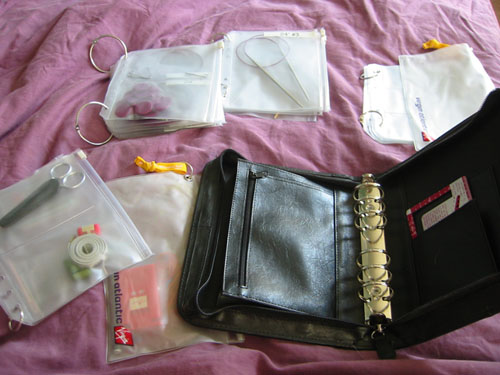
<p>Here's everything, now.  OK, I still have a bunch of straight needles that I'm probably going to give away, and those are stored in a big roll-up needle holder, but this is the stuff I'm using regularly.</p>

<p><img src="http://www.blue-room.com/ducks/images/IMG_7646_edited.jpg" height="375" width="500" border="0" hspace="0" vspace="0" alt="All the knitting junk" /></p>

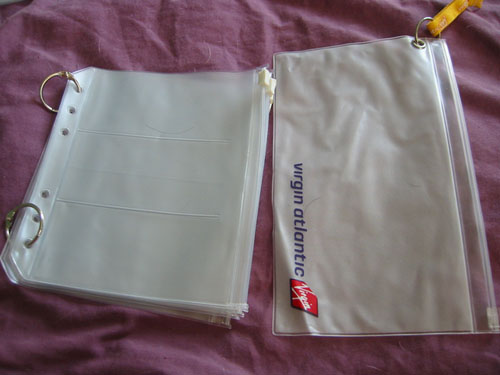
<p>What's in there, anyway?  Well, I got the storage pages from <a href="http://www.knitpicks.com/">KnitPicks</a>, and tied them into bunches with some loose binder rings.  I also have the big binder thing that comes with the set, but I find it can't hold as much as I want, and then it's hard to separate the pages into categories.  I'm still deciding whether I will use the binder for current projects or not.</p>

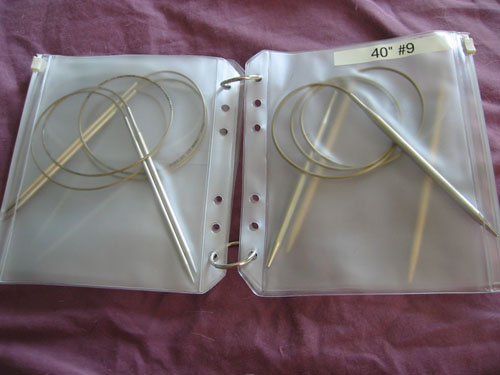
<p>In this first set of pages, I have some ordinary circular needles of various sizes.  Some of these I will eventually get rid of, because I don't really need them any more.  The pages are labeled with the size of the needle and its length.</p>

<p><img src="http://www.blue-room.com/ducks/images/IMG_7647_edited.jpg" height="375" width="500" border="0" hspace="0" vspace="0" alt="Some circular needles" /></p>

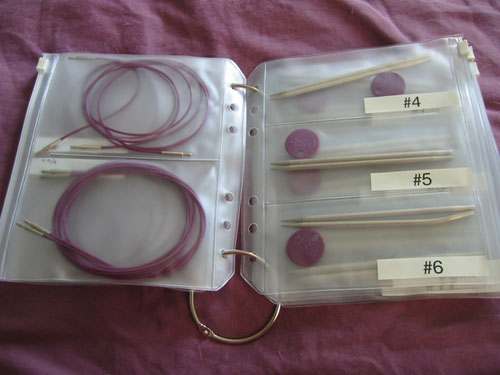
<p>In another bundle, I have all the bits and bobs from the set of KnitPicks Options needles I bought this summer.  I'm very happy with this set because not only are they very fine circular needles, but they can be set up to operate as straight needles, too.  Four of the pages that have three pockets will hold all the tips currently available from KnitPicks.  Again, I labeled them with the size.  The cables are stored in two-pocket pages and also labeled with their length.</p>

<p><img src="http://www.blue-room.com/ducks/images/IMG_7648_edited.jpg" height="375" width="500" border="0" hspace="0" vspace="0" alt="The Knitpicks Options set" /></p>

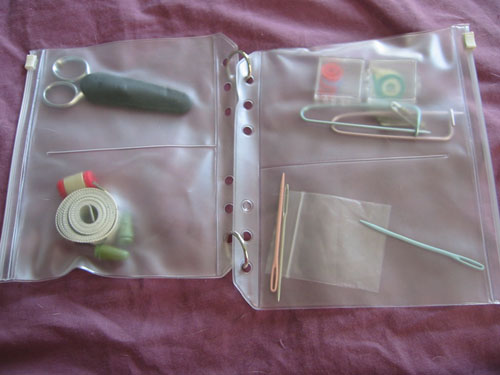
<p>Another bundle of pages holds my little tool bits.  Markers, cable needles, my little embroidery scissors, measuring tape, that sort of thing.  I used to have a lot more of this stuff, but I've been getting rid of the things I don't use very often or only use out of guilt.</p>

<p><img src="http://www.blue-room.com/ducks/images/IMG_7649_edited.jpg" height="375" width="500" border="0" hspace="0" vspace="0" alt="Accessories" /></p>

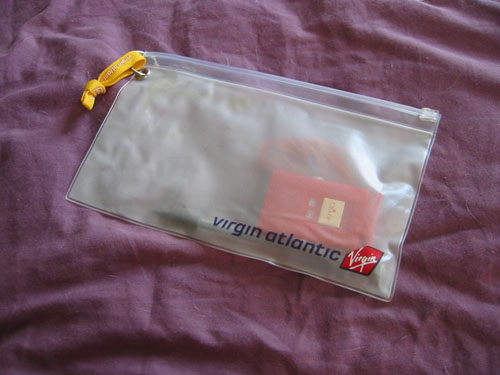
<p>I use this little bag to hold the tools for my current project.  Mostly things that would get snagged on the yarn in the knitting bag.  It's a toiletries kit from an international flight on Virgin.  I like that it is see-through, so if I'm looking for something I can locate it from the outside instead of having to dig around.</p>

<p><img src="http://www.blue-room.com/ducks/images/IMG_7650_edited.jpg" height="375" width="500" border="0" hspace="0" vspace="0" alt="Current project stuff" /></p>

<p>And I had a few bags and things left over.  Nice if I break something, or get more stuff and need to have more space, but also nice to keep away from the main working tools.</p>

<p><img src="http://www.blue-room.com/ducks/images/IMG_7651_edited.jpg" height="375" width="500" border="0" hspace="0" vspace="0" alt="Extra storage bits" /></p>

<p>I've been looking for a cheap cardboard 6-ring binder to hold these together, but the loose binder rings work very well and the pages fit nicely into a little box I have, so this system will work just fine.  Now I can stop obsessing about getting it all organized and perfect, and actually do some knitting.<br />
<!-- technorati tags start --><p style="text-align:right;font-size:10px;">Technorati Tags: <a href="http://www.technorati.com/tag/crafts" rel="tag">crafts</a>, <a href="http://www.technorati.com/tag/knitting" rel="tag">knitting</a>, <a href="http://www.technorati.com/tag/organization" rel="tag">organization</a></p><!-- technorati tags end --></p>]]>
        
    </content>
</entry>

<entry>
    <title>Let the Machine Remember For You</title>
    <link rel="alternate" type="text/html" href="http://www.blue-room.com/ducks/archives/001039.html" />
    <link rel="service.edit" type="application/atom+xml" href="http://admin.blue-room.com/movabletype/mt-atom.cgi/weblog/blog_id=9/entry_id=1039" title="Let the Machine Remember For You" />
    <id>tag:www.blue-room.com,2006:/ducks//9.1039</id>
    
    <published>2006-06-06T02:26:00Z</published>
    <updated>2007-10-08T15:27:28Z</updated>
    
    <summary>If there are routine things you have to do that you keep forgetting, it may be time to think about how you can avoid having to remember them in the first place. Oh, yes, there are calendars and alarms and...</summary>
    <author>
        <name>Ayse</name>
        <uri>http://www.casadecrepit.com/</uri>
    </author>
    
        <category term="improving" />
    
    <content type="html" xml:lang="en" xml:base="http://www.blue-room.com/ducks/">
        <![CDATA[<p>If there are routine things you have to do that you keep forgetting, it may be time to think about how you can avoid having to remember them in the first place.</p>

<p>Oh, yes, there are calendars and alarms and all that, but maybe the best solution is to not have to think about it in the first place.  Electronic bill paying is an obvious example of this: you can monitor it, but you don't need to worry about whether you've paid the gas bill on time.</p>

<p>Then there's thermostat timers that turn the heat up or down depending on the time of day -- I'm so dependent on mine I can't imagine living without it.  No more forgetting to turn down the heat before bed, or coming home to a cold house, or spending too much time thinking about whether it is time to fiddle with the heating controls.  That brain space can be used for something else.</p>

<p>How about some other daily running worries that you can eliminate with automation?  An appliance timer can turn on the coffee machine for you in the morning (or they make machines with timers built in) and turn it off for you, too.  You can buy a kit to put little drip emitters in your potted plants, and hook that up to a timer, too.  Imagine never killing a plant by forgetting to water it again.  We have a timer on our shower ventilation fan, so it runs for thirty minutes after you turn it on to suck the humid air out of the room, then shuts off automatically.  Bliss.</p>

<p>You can use automation (and appliance timers) to help make lifestyle changes.  Want to cut down on your TV viewing?  Put the TV on an appliance timer and it will be turned off for you when the limit is up.  It's obviously trivial to override the system, but it requires real thinking about whether you want to watch TV now or not.  </p>

<p>The real beauty of the automated system is that you can turn off that background process that is always nagging you to remember things.  The machines, which are really good at remembering things, will do that for you.  You can do the stuff that your brain is really good at.<br />
<!-- technorati tags start --><p style="text-align:right;font-size:10px;">Technorati Tags: <a href="http://www.technorati.com/tag/automation" rel="tag">automation</a></p><!-- technorati tags end --></p>]]>
        
    </content>
</entry>

<entry>
    <title>Do It Wrong</title>
    <link rel="alternate" type="text/html" href="http://www.blue-room.com/ducks/archives/000938.html" />
    <link rel="service.edit" type="application/atom+xml" href="http://admin.blue-room.com/movabletype/mt-atom.cgi/weblog/blog_id=9/entry_id=938" title="Do It Wrong" />
    <id>tag:www.blue-room.com,2006:/ducks//9.938</id>
    
    <published>2006-03-01T19:43:46Z</published>
    <updated>2006-03-01T17:45:30Z</updated>
    
    <summary>I have really long hair, and supposedly the right way to brush really long hair is to start at the tips and work your way to the crown of your head, brushing only a few inches at a time, to...</summary>
    <author>
        <name>Ayse</name>
        <uri>http://www.casadecrepit.com/</uri>
    </author>
    
        <category term="motivation" />
    
    <content type="html" xml:lang="en" xml:base="http://www.blue-room.com/ducks/">
        <![CDATA[<p>I have really long hair, and supposedly the right way to brush really long hair is to start at the tips and work your way to the crown of your head, brushing only a few inches at a time, to prevent knots.</p>

<p>Give me a break.</p>

<p>One of the worst things you can do is the simple act of thinking about how to do something the right way.  Don't do it right, don't be perfect.  Just do it, and if it's half-assed, at least it's done!</p>

<p>Consider this: I need to build a trellis for some roses.  I've been in a minor obsession about this all week, thinking of where to get the materials and how to put it together.  Because it needs to be <i>just perfect</i>.  Instead, I should either a) go buy a cheap, imperfect trellis, or b) just get some stuff and put the thing together, figuring it out as I go.  In either case I would already have the trellis and I could obsess about something else for a while.</p>

<p>Do work when you know you don't have enough time to do it right.  Pick something up and throw it out on the way to the door.  Clean the sink, but don't scrub it out and clean all the gunk around the faucets.  Be imperfect, do a slap-dash job.  It'll get you further than sitting around, paralyzed by the need to be perfect.<br />
<!-- technorati tags start --><p style="text-align:right;font-size:10px;">Technorati Tags: <a href="http://www.technorati.com/tag/advice" rel="tag">advice</a>, <a href="http://www.technorati.com/tag/resolutions" rel="tag">resolutions</a></p><!-- technorati tags end --></p>]]>
        
    </content>
</entry>

<entry>
    <title>Tossing the Junk</title>
    <link rel="alternate" type="text/html" href="http://www.blue-room.com/ducks/archives/000899.html" />
    <link rel="service.edit" type="application/atom+xml" href="http://admin.blue-room.com/movabletype/mt-atom.cgi/weblog/blog_id=9/entry_id=899" title="Tossing the Junk" />
    <id>tag:www.blue-room.com,2006:/ducks//9.899</id>
    
    <published>2006-01-03T18:44:06Z</published>
    <updated>2006-01-03T17:15:23Z</updated>
    
    <summary>One of the things I have had trouble with while dieting is avoiding snacking rather than eating meals. In September I changed my diet to be three meals a day, doing away with snacks in order to save my calories...</summary>
    <author>
        <name>Ayse</name>
        <uri>http://www.casadecrepit.com/</uri>
    </author>
    
        <category term="decluttering" />
    
    <content type="html" xml:lang="en" xml:base="http://www.blue-room.com/ducks/">
        <![CDATA[<p>One of the things I have had trouble with while dieting is avoiding snacking rather than eating meals.  In September I changed my diet to be three meals a day, doing away with snacks in order to save my calories for a really filling meal.  </p>

<p>To keep myself on track, I threw away all my snack food.</p>

<p>You know this stuff: it's the mac-n-cheese boxes you bought on sale, brownie mix, cookies, a candy bar or two, crackers and cheese, even bowls of cereal that you can pretend are actually healthy.  When you're ranging around the house wanting to chew on something, this stuff is right there, and before you know it you've eaten 350 calories of food you didn't need to eat.  A week or so of that and you've gained a pound without really trying.</p>

<p>So I threw it out.  All that snack food.  It was an enormous waste of food (actually, not so much because I had eaten most of it, but I filled one trash bag).  But then it was gone and I made a decision to stop bringing it in the house (if you have a partner who brings this stuff home and won't stop to help you out, I have no help for you; if you have kids, remember that you're the parent, and you're the one who gets to decide what they eat).  When I only had food for my three meals, I found myself snacking a lot less.  I would feel a little hungry, and check the fridge.  There would be makings for a whole meal, but that seemed like too much effort.  So instead I would have a glass of water and walk around a bit, or take a break from what I had been doing to read a book or do some knitting.  Usually feeling hungry was just being tired of doing work I was not enjoying, or being bored with something tedious.</p>

<p>I also got rid of snack food I used to keep on my desk.  I'd find myself eating that all afternoon instead of having lunch and then dinner, so I dumped it and made a ritual out of going to have those meals instead.  It actually didn't work out to fewer calories to eat that way, but my digestion improved and I was eating much healthier foods than I had been.</p>

<p>Christmas is the worst.  Everybody gives you chocolate and cookies and cake, and you go to cocktail parties with trays of food lying around to graze on.  So I set a deadline: anything left after January 6 (the Feast of the Epiphany, and the official end of Christmas) goes in the trash or gets given away to somebody who wants the calories.  I don't need it, and I don't want the consequences of eating it.</p>

<p>You'd be surprised how easy it is to throw away food.  When you make the decision, it feels so freeing, as if you've thrown away some of that body fat.  Better, of course, is to not buy the stuff in the first place, but we're not all perfect all the time.  Instead of eating your way through your grocery store mishaps, give them to a food bank (now that Christmas is over they will need your donations) or throw them away.</p>

<p><!-- technorati tags start --><p style="text-align:right;font-size:10px;">Technorati Tags: <a href="http://www.technorati.com/tag/dieting" rel="tag">dieting</a>, <a href="http://www.technorati.com/tag/food" rel="tag">food</a></p><!-- technorati tags end --></p>]]>
        
    </content>
</entry>

<entry>
    <title>On Making Resolutions</title>
    <link rel="alternate" type="text/html" href="http://www.blue-room.com/ducks/archives/000898.html" />
    <link rel="service.edit" type="application/atom+xml" href="http://admin.blue-room.com/movabletype/mt-atom.cgi/weblog/blog_id=9/entry_id=898" title="On Making Resolutions" />
    <id>tag:www.blue-room.com,2006:/ducks//9.898</id>
    
    <published>2006-01-03T18:21:46Z</published>
    <updated>2006-01-03T17:16:54Z</updated>
    
    <summary>You&apos;d think that somebody as obsessed as I am with the idea of making things better would be a big supporter of New Year&apos;s resolutions. You&apos;d be wrong. I stopped making (and trying to keep) New Year&apos;s resolutions five years...</summary>
    <author>
        <name>Ayse</name>
        <uri>http://www.casadecrepit.com/</uri>
    </author>
    
        <category term="motivation" />
    
    <content type="html" xml:lang="en" xml:base="http://www.blue-room.com/ducks/">
        <![CDATA[<p>You'd think that somebody as obsessed as I am with the idea of making things better would be a big supporter of New Year's resolutions.  You'd be wrong.  I stopped making (and trying to keep) New Year's resolutions five years ago, and I haven't regretted it one bit.</p>

<p>Does that mean I never decide to make big changes to improve my life?  Um, no, obviously not.  What it means is that when I decide to make a change, I <i>do it right then</i>, rather than waiting for some arbitrary date.  I do this for any number of reasons, but primarily because this keeps me from putting off doing it, creating arbitrary reasons to delay starting the change ("I'll start my diet at noon, no after lunch, no, today is really a hangover day; I'll start tomorrow") and inevitably failing.</p>

<p>By starting right away, I make it clear to myself that I want to make this change, and I have decided to make it.  It's important to me, so important that getting started has to happen as soon as I decide it's important.  By not delaying starting, I show myself how important this change is.</p>

<p>One benefit to starting right away is that I can make changes in my life at any time.  In early December I decided to change one simple thing I was doing every day, and I started right then.  If I had waited until the New Year, I'm not sure that I would have done it, and I certainly would not have reaped the benefits of having made this little change for the entire month of December.  So I start the New Year feeling like I've really made something happen, rather than with an encroaching sense of dread about not being able to keep resolutions.</p>

<p>Starting right away also maintains momentum.  I had a crisis, I came to a resolution, I made a decision, and immediately I take an action.  No waiting around.  Just go out and do it.  It's so much easier that way, without any starting and stopping.</p>

<p>Five years ago, when I sat down to think about what I wanted to change about my life in the year to come, I realized that what I wanted to do I should have started to do already, and that if I really wanted to make positive change in my life, I had to stop waiting for significant dates and behaving so superstitiously about when I would start.  I realized that in previous years I had read a lot of articles about New Year's resolutions and how few people keep them, and that that negative press was hurting me.  So I decided to get off that ride.</p>

<p>Now, when I fail to keep a resolution, I don't feel like the world is saying, "I told you so."  I can pick myself up and get back on the horse, or I can change what I was doing again, trying to find something that works.  I shifted my way of thinking from strongly negative, maybe not all the way to strongly positive, but positive enough that if I fail at something, I have enough self-esteem left to get up and start over again.</p>

<p>The much-touted benefit of New Year's resolutions is supposed to be that everybody else is making them.  There are some benefits to making resolutions with other people, of course, as long as they actually help you stick to them.  Making a resolution with a friend who will help you stay on track is really helpful: I do that, but not for January first.   And I choose well the friends I make resolutions with: they have to be people I can trust to support me in the resolution, not saboteurs or critics.</p>

<p>Resolutions and decisions are the core of changing your life.  Don't let them be guided by superstitious cultural quirks.  If you mean it, do it.</p>]]>
        
    </content>
</entry>

<entry>
    <title>Team Decluttering</title>
    <link rel="alternate" type="text/html" href="http://www.blue-room.com/ducks/archives/000891.html" />
    <link rel="service.edit" type="application/atom+xml" href="http://admin.blue-room.com/movabletype/mt-atom.cgi/weblog/blog_id=9/entry_id=891" title="Team Decluttering" />
    <id>tag:www.blue-room.com,2005:/ducks//9.891</id>
    
    <published>2005-12-18T22:41:23Z</published>
    <updated>2005-12-18T20:43:34Z</updated>
    
    <summary>We tried out a new way of getting rid of stuff this weekend: Team Decluttering. Get two people together. Lay down some ground rules, like no personal attacks or mean-spirited comments. You&apos;re decluttering stuff, not each other. As you go...</summary>
    <author>
        <name>Ayse</name>
        <uri>http://www.casadecrepit.com/</uri>
    </author>
    
        <category term="decluttering" />
    
    <content type="html" xml:lang="en" xml:base="http://www.blue-room.com/ducks/">
        <![CDATA[<p>We tried out a new way of getting rid of stuff this weekend: Team Decluttering.</p>

<p>Get two people together.  Lay down some ground rules, like no personal attacks or mean-spirited comments.  You're decluttering <i>stuff</i>, not each other.  As you go through stuff, switch off acting as a questioner: "Why do you want to keep that?  When was the last time you used it?  Can we just rent one when needed?"  Be aggressive, but be nice.  Sometimes the decluttering person will want to get rid of something the questioner wants to keep; then you switch roles, basically.</p>

<p>Some people find it easier to be the questioner, some people prefer to be the declutterer.  Others like both roles.  Switch them back and forth.</p>

<p>We filled six grocery bags with stuff to give away in a few hours doing this.  And we're hardly at the stage of decluttering where that's routine.  The best part is that it's a shared activity, rather than a solitary thing.  </p>]]>
        
    </content>
</entry>

<entry>
    <title>Rethink Your Systems</title>
    <link rel="alternate" type="text/html" href="http://www.blue-room.com/ducks/archives/000883.html" />
    <link rel="service.edit" type="application/atom+xml" href="http://admin.blue-room.com/movabletype/mt-atom.cgi/weblog/blog_id=9/entry_id=883" title="Rethink Your Systems" />
    <id>tag:www.blue-room.com,2005:/ducks//9.883</id>
    
    <published>2005-12-05T06:55:50Z</published>
    <updated>2007-01-23T02:54:03Z</updated>
    
    <summary>When you&apos;ve been working with a system for a while, it can get bogged down on itself. You&apos;ll notice it when you try to use the system: things will be in your way, you&apos;ll notice something that you haven&apos;t used...</summary>
    <author>
        <name>Ayse</name>
        <uri>http://www.casadecrepit.com/</uri>
    </author>
    
        <category term="decluttering" />
    
    <content type="html" xml:lang="en" xml:base="http://www.blue-room.com/ducks/">
        <![CDATA[<p>When you've been working with a system for a while, it can get bogged down on itself.  You'll notice it when you try to use the system: things will be in your way, you'll notice something that you haven't used in forever that's just sitting around in a prime location.  Maybe you've changed some way you do things and you use certain tools more often than you did; maybe you've been working on a project that requires different tools than you usually use.  It's not that you don't need the stuff around you, per se, but more that you need it to be in a different order.</p>

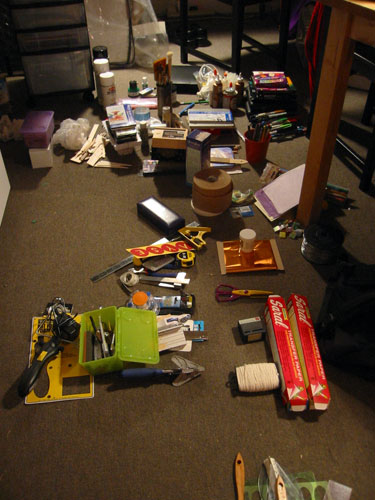
<p>Find a time when you can sacrifice efficiency and reorganize.  For me, that meant that today, after I brought all my studio supplies home, I took them all out of their boxes and drawers and so forth and figured out what I had.</p>

<p><img src="http://www.blue-room.com/ducks/images/IMG_5793_edited.jpg" height="500" width="375" border="0" hspace="0" vspace="0" alt="Massive declutter" /></p>

<p>The first thing I did, as I emptied the containers, was to sort things by type.  In the foreground, you can see a pile of cutting tools.  There's also a pile I was thinking of as "assorted" running along the back (I was sitting in that clear spot in the middle left).  I put some gilding supplies, a pair of scallop scissors, twine, a slide viewer, and the carbon paper there. Most of that stuff will end up being stored somewhere; some of it will be thrown away (I'm considering it for the fake-copper foil from a project last year).</p>

<p>With everything sorted out and in front of me, I threw some stuff out.  But not much -- these are working supplies and they've already been decluttered.  I'm not concentrating on getting rid of things, just streamlining how I access them.</p>

<p>I chose one set of storage drawers -- I have three, but two are very heavy and I'd rather not haul them into studio every twelve weeks -- and put the most critical and frequently used items from the piles in there.  You can see the bottom of the drawers in the top of the picture: they're garden-variety plastic storage drawers from a household goods store.  Lightweight, relatively durable, and on casters to make them easier to move.  My studio next quarter is on the third floor.</p>

<p>The bottom drawer is entirely devoted to glue -- I use glue a lot and have lots of different kinds, and I need it at hand pretty much all the time.  I used the bottom drawer because it was the tallest and could hold the most bottles of glue upright, which is generally a good way to store glue bottles.  It ended up half empty, but half empty is easier to deal with than crammed full.</p>

<p>The next drawer was for papers.  They lie flat in there and are easy to leaf through.  Actually, I didn't even move the stack that I'd stored in there earlier.</p>

<p>Then a drawer for scraps of wood -- I save these for projects where I need small bits -- and rolls of tape.  I spent most of my time this evening sorting out the scraps of wood and throwing away from of the smaller, less obviously useful ones.  I am not likely to use those, and I have plenty of others.  I can't wait to graduate and throw all of them away.  Or give them to an underclassman.</p>

<p>The next drawer was filled with those cutting tools (except the large electric foam cutter, which I don't need very often).  I was surprised at how many I had.</p>

<p>Then the top drawer took a pile of hand tools from the center of the photo, plus my safety goggles for the workshop, some twine, and my stash of bandages and ibuprofen.</p>

<p>So, you ask, what of the rest of that stuff?</p>

<p>I've found, over the last couple of quarters, that I need things in batches, and I usually have a day or more of notice for needing them.  So my collection of wood, rolls of paper, and other oddments can stay at the house, to be brought in as needed.  So can the drawing pencils, coloured pencils, pastels, charcoals, most of the paint, and markers.  I'm going to get some easily portable boxes for these, like I have for some other categories of supplies (mold making and wire, for example) and when I need those things, I can just grab the box and bring it in with me.  Until then, it can stay in storage at the apartment, out of the way of the heavy work.</p>

<p>There are some things I'm going to need to bring in that didn't fit into the drawers.  My drafting tools, for example, and some watercolours and drawing pens.  I'll probably put those in their own boxes or containers and just bring them in with everything else at the beginning of the quarter.</p>

<p>Right now, I'm very happy with my streamlined tools.  I've been wanting to pare down what I bring to studio, so I have more room to work and the things I need are all together and where I want them.  Having this stuff in order makes me feel more productive.   If I get started on next quarter and this whole system fails me, I can always gather up my boxes of supplies and haul them into the studio.  Then at the end of the quarter I can reassess the system again.</p>]]>
        
    </content>
</entry>

<entry>
    <title>10 Ways to Simplify Your Life</title>
    <link rel="alternate" type="text/html" href="http://www.blue-room.com/ducks/archives/000857.html" />
    <link rel="service.edit" type="application/atom+xml" href="http://admin.blue-room.com/movabletype/mt-atom.cgi/weblog/blog_id=9/entry_id=857" title="10 Ways to Simplify Your Life" />
    <id>tag:www.blue-room.com,2005:/ducks//9.857</id>
    
    <published>2005-11-10T09:36:46Z</published>
    <updated>2005-11-10T07:37:36Z</updated>
    
    <summary>The first thing you should know is that simple doesn&apos;t mean cheap, it doesn&apos;t mean fast. It means easy. And easy for me doesn&apos;t mean easy for you. I&apos;ve tried to make these as generic as possible, but if you&apos;re...</summary>
    <author>
        <name>Ayse</name>
        <uri>http://www.casadecrepit.com/</uri>
    </author>
    
        <category term="improving" />
    
    <content type="html" xml:lang="en" xml:base="http://www.blue-room.com/ducks/">
        <![CDATA[<p>The first thing you should know is that simple doesn't mean cheap, it doesn't mean fast.  It means <i>easy</i>.  And easy for me doesn't mean easy for you.  I've tried to make these as generic as possible, but if you're looking at one of them and thinking about how complicated that would be to use in your own life, it's time to read suggestion #8 below.</p>

<p><b>1. Know your priorities</b></p>

<p>The most important thing you can do to make your life simpler is to know what is important to you.  When you know what is important to you, you can easily tell when you're being roped into doing something that's important to somebody else.  There are, of course, plenty of occasions where that happens, but not all of them deserve the same amount of your attention and time and energy.  </p>

<p>I keep a list of the five things that are most important to me at any time.  Just looking at that list reminds me of what I should really be spending my time on, and helps me know when a time-sucking project should be dumped.</p>

<p><b>2. Remove choices</b></p>

<p>Remember when there were only 4 channels on TV?  It was a lot easier to choose what you wanted to watch then, wasn't it?  When we had a satellite TV service, we programmed the "Station Guide" to show us only the few channels we actually watched.  It made deciding whether there was anything good on TV a lot easier.</p>

<p>There are other ways you can use this.  If you have trouble deciding what to wear in the morning, consider <a href="http://www.blue-room.com/ducks/archives/000784.html">engineering your wardrobe</a>.  Get rid of redundant pairs of shoes, multiple bottles of shampoo, whatever you have that makes you pause during your day and decide among what seems like endless alternatives, reduce those alternatives to the highest-value and make the decision easier.</p>

<p>Another good way to do this is to arrange the movies you own by last-watched date.  So when you're looking for something to watch, you can grab the one at the top of the pile.  This works best if you don't keep movies you hate (or even ones you're indifferent to; the idea is to make an easy choice that results in a desired outcome, not to just fill your time).</p>

<p><b>3. Make decisions once</b></p>

<p>Speaking of removing choices, some decisions really only need to be made once.  If you're constantly trying to come up with meals that are nutritionally balanced and tasty, you should really be writing down the menus you come up with and putting them in a notebook somewhere handy so you can use them again.  I keep track of the calories in the food I eat, but I don't recalculate them every time.  I just reuse the same calculations I made months ago.</p>

<p><b>4. Build generalized systems</b></p>

<p>I have a little motto: "If it worked once, it will work twice."  It doesn't mean what you think it means.  It means that if standardizing your wardrobe worked well, then standardizing your eating habits will also work well.  I like making decisions into little pellets that I don't have to handle too much, and that works for me.  I have my simple wardrobe where no outfit can be bad, and a simple set of meals that I choose from.  Pellets work for me.  </p>

<p>If you function best with more choices --perhaps having the Chinese menu type approach (pick one from each column and everything is OK) -- then use that approach for more than just getting dressed or choosing dinner.  Use it for buying toiletries, for example.  It worked for you once.  Try it again.</p>

<p><b>5. Keep your memory outside of your brain</b></p>

<p>This is a basic one.  Don't try to keep track of to-do lists or systems or pre-made decisions in your head.  Just write them down.  A few sheets of paper are fine.  I like a dedicated notebook.  Some people use their computers.  Just get it out of your head.  Knowing you're free to forget it without losing it forever will take a load off your mind.</p>

<p><b>6. Avoid technical solutions</b></p>

<p>If you're trying to solve a problem with your life getting too complicated, the way <i>not</i> to make it come together fast is to buy or download a bunch of highly specialized software that is supposed to make your like a hundred times easier.  If you are having trouble getting your life together, spending every night for two months building a perfect database with all the fields you need and an open data structure might get you a nice piece of software, but it's not making your life simpler.</p>

<p>Or if you already have this stuff, don't try to learn every trick in the world to make it work best.  Constantly optimizing your systems adds complication.</p>

<p>If you find that stuff fun, have at it, but do it during your "free" time and do it because you love it.  Gearing up won't make your life simpler.  It will just add one more thing for you to think about.</p>

<p><b>7. Put it in front of you</b></p>

<p>Whatever is in your line of sight will get noticed.  So when I need to keep something in the front of my brain, I put it in the middle of my desk.  If you look at my desk, it is actually a map of how critical various projects are to me at any given moment.  The center is where I have what I am working on right now.  Around that are supporting projects or unrelated projects that I need to keep in my mind.  On the very edges are things that related to important projects but are not of themselves important.</p>

<p>I use this system in other ways, too: pieces of projects I'm working on go on my computer's desktop; my pile of things to take with me from house to house goes in the middle of the table; my morning to-do list is at the top of the notebook page for that day.  </p>

<p>Another way I use this is to leave myself notes.  If I keep forgetting to make sure the cabinet doors are closed (I'm trying to learn to do this automatically), I put a note where I'll see it when I leave the kitchen that says, "SHUT THE DOORS!"  For a while I had a note on the door that said, "Did you brush your hair?" because for some reason I kept walking out the door and realizing my head was a tangly mess.</p>

<p>People who come to visit may think you are insane, but you won't be walking around with the feeling that there was something you were supposed to do.</p>

<p><b>8. Get lazy</b></p>

<p>I think the best engineers are the laziest engineers.  Frank Gilbreth always wanted to see how the laziest person on the assembly line worked.  There is a simplicity in laziness.  When you're looking at a problem and having trouble coming to grips with how to approach it, imagine the way you would deal with it if you were much lazier.</p>

<p>For example, I could have written my own content-management system.  But Movable Type was much easier, and instead of requiring real dedication on my part, it took me all of a few hours to install and get running, and that was only because Perl needed upgrading.  I could use a more flexible system, but I've got Movable Type up and running.</p>

<p>Laziness keeps you from spending time and energy on things that are not important to you.  If half as good is good enough, why on earth are you spending the extra energy?  It better be because it gets you something you want.</p>

<p><b>9. Embrace handwaving</b></p>

<p>This is my big bugaboo.  I'll spend weeks and months agonizing over all details of a project, trying to get all the tiny details perfect.  This is so unnecessary.  Sometimes, it's easier to make a decision after you have gotten started.  So I'm teaching myself to insert "handwaving here" into my plans.  When I get to that, I know I shouldn't try to figure out exactly which PVC connectors I will need for the pond filter system until I start assembling the thing, for example.  I can always make a couple trips to the store during the day.</p>

<p><b>10. Overestimate</b></p>

<p>You can spend a lot of time trying to get every estimate perfect, and still be wrong.  So if you're trying to decide when to leave to get to a meeting on time, give yourself 10% more time than you needed.  Don't book a flight that lands an hour before your presentation.  Buy more plywood than you think you need for the project.  Make too much food for a party.</p>

<p>Not having to engineer everything will make the process easier.  And if you do make order-of-magnitude mistakes, you can make note of them and fix them next time.  </p>]]>
        
    </content>
</entry>

<entry>
    <title>The Value of a Deadline</title>
    <link rel="alternate" type="text/html" href="http://www.blue-room.com/ducks/archives/000853.html" />
    <link rel="service.edit" type="application/atom+xml" href="http://admin.blue-room.com/movabletype/mt-atom.cgi/weblog/blog_id=9/entry_id=853" title="The Value of a Deadline" />
    <id>tag:www.blue-room.com,2005:/ducks//9.853</id>
    
    <published>2005-11-01T06:59:52Z</published>
    <updated>2005-11-01T04:00:37Z</updated>
    
    <summary>In honour of NaNoWriMo, the annual contest to write a 50,000-words novel in a month, I&apos;ve been thinking about the value of arbitrary deadlines and goalposts. It can be hard to think about time in large units. To plan massive...</summary>
    <author>
        <name>Ayse</name>
        <uri>http://www.casadecrepit.com/</uri>
    </author>
    
        <category term="motivation" />
    
    <content type="html" xml:lang="en" xml:base="http://www.blue-room.com/ducks/">
        <![CDATA[<p>In honour of <a href="http://www.nanowrimo.org/">NaNoWriMo</a>, the annual contest to write a 50,000-words novel in a month, I've been thinking about the value of arbitrary deadlines and goalposts.</p>

<p>It can be hard to think about time in large units.  To plan massive projects or stay motivated by a goal many years in the future.  So I trick myself by aiming at micro-goals: when I was running in high school I would do sets of sprints up a hill that was longer than I planned to go.  When I was almost at the point where I had planned to stop, I would extend the goalpost a little: tell myself I would run as far as that light post ahead, or to that mailbox.  I tricked myself into doing a bit more than I thought I could.</p>

<p>I use the same technique now with work I'm not keen on doing (alas, I get no runner's high from sweeping).  I'll set out to do a project with a small time limit on it: 20 minutes of taking books down and dusting them, for example.  Then I'll extend the goalpost, and decide to just finish this row of books.  </p>

<p>Some people think that there's a real power in stopping where you are, but I find that discouraging.  I don't like seeing jobs half-done, or stopped at odd points.  For me, stopping at a sensible point not only leaves a room or job more orderly, but it gives me the feeling that I did more than I was supposed to, which is a good feeling.</p>

<p>So if I were to be writing a novel for NaNoWriMo, I would take the number of writing days in the month and divide the word count by them.  Let's say I knew I would not be writing over Thanksgiving, so there are only 25 writing days in the month (also, it makes the math easier).  That means I'd have to write a minimum of 2000 words per day.  That's a doable amount for me, because I write fast and furious when I'm writing (when I freelanced I wrote at least 10,000 words a day on top of a full-time job, though those edited down to considerably fewer), but it's a heck of a lot if you've never written professionally.  Heck, even if you have written professionally, 2000 good words a day is some work.  So chop it up.  Plan to write 1000 words, then challenge yourself to write another 200, and then another 200, and so on.  See if you can't add an extra 200 while you're there: every extra word you write earlier in the month is a word you won't have to write later.  Set up your goalposts, but keep moving them.</p>

<p>Another great use for a slam project like NaNoWriMo is a massive decluttering.  It's getting near the holidays, when people entertain more, and maybe you want to get the house in shape.  Why not set a goal of decluttering a square yard every day?  Or map out the month with a goal for every day: tomorrow I'll sort the paperwork on the desk, Wednesday I'll clean the crisper drawer in the refrigerator.  As you do each task, you can add on to it, go a little further.  You'd be shocked at how much you can get done with small goals and big pushes.</p>]]>
        
    </content>
</entry>

<entry>
    <title>Getting Ready to Sell</title>
    <link rel="alternate" type="text/html" href="http://www.blue-room.com/ducks/archives/000843.html" />
    <link rel="service.edit" type="application/atom+xml" href="http://admin.blue-room.com/movabletype/mt-atom.cgi/weblog/blog_id=9/entry_id=843" title="Getting Ready to Sell" />
    <id>tag:www.blue-room.com,2005:/ducks//9.843</id>
    
    <published>2005-10-17T03:56:24Z</published>
    <updated>2008-09-17T14:58:39Z</updated>
    
    <summary>I&apos;ve been reading a lot of web sites with tips on how to sell your house faster lately. Not because I want to sell my beloved pile, but because they give me good ideas about how to make fast, cheap...</summary>
    <author>
        <name>Ayse</name>
        <uri>http://www.casadecrepit.com/</uri>
    </author>
    
        <category term="improving" />
    
    <content type="html" xml:lang="en" xml:base="http://www.blue-room.com/ducks/">
        <![CDATA[<p>I've been reading a lot of web sites with tips on how to sell your house faster lately.</p>

<p>Not because I want to sell my beloved pile, but because they give me good ideas about how to make fast, cheap changes to where I live.  In fact, many of the tips make me wonder why people would not do that to begin with.</p>

<p>For example: <b>Sweep the front walk and plant some flowers.</b>  These are a couple simple ways to make a house look more inviting and home-like.  So why do people even have to be told that? Because when it's your own house, it <i>is</i> home, so you don't need to make it look more that way to sell yourself.  On the other hand, doing some landscaping around the house will make you happy every time you see it, and it's relatively cheap.  Just remember to water those plants.</p>

<p><b>Don't mask smells with scented products.</b>  The real estate agents rightly point out that this will make everybody who visits you wonder what you're trying to cover up.  Smells come from somewhere: find out where and get rid of it (musty bathrooms may need a ventilation fan replaced or installed).  Wash your kitchen floors and walls regularly (yes, the walls get dirty if you cook at home).  You want people to notice a nice, fresh, clean smell when they walk in the door, not "Clean Scent" deodorizer.</p>

<p><b>Have you considered painting those rooms?</b>  A fresh coat of paint can really spruce up a room, especially if it is not plain white.  Lots of people paint once before they move in and never paint again because it will be too much effort.  Well, use the opportunity to declutter all the stuff piled around the walls and paint that room.  While you're at it, <b>washing the glass covers on light fixtures regularly</b> not only brightens the place up, but removes any fly corpses waiting up there to gross somebody out.</p>

<p><b>Don't turn on all the lights</b>, or <b>use side lights instead of overhead lighting</b>.  Let's face it, overhead lighting sucks.  It glares, it is unflattering, and it takes all the character out of a room.  Table lamps and floor lamps can make a room much more attractive and interesting, and it doesn't take much effort to use them rather than a horrible overhead light.</p>

<p><b>Dump the knick-knacks</b>.  Large collections especially.  They look busy and get dusty fast, and it's hard to appreciate anything small and grouped together from ten feet away.  The test I give little jobbies is this: when I'm doing anything other than looking at them, are they in scale with what I'm doing, or too small or too large?  I have smaller things on bookshelves (one or three in a space between books), larger things in a shelf by themselves, and the few very large things I have are either furniture or garden ornaments.  I don't have room for a life-sized stuffed panda in my living room.</p>

<p><b>Hire a cleaning service to give the place a going-over</b>.  Agents hire cleaning services to get the stuff we miss every day, like the gunge that builds up around faucets, and the grease in cracks in the cupboards -- this is the stuff buyers notice right away, but don't think you never see it, even if you never notice it.  We hired a cleaning service to come every other week and do the big stuff (floor washing) and the details (gunge removal), but you can make a huge difference in your house by hiring a service as infrequently as twice a year for a thorough cleaning.  Costs vary depending on what you want done.  Make sure to have them dust your bookshelves, because you would not believe what is in there.</p>

<p><b>Clean the curtains and carpets regularly</b>.  We tend to forget the curtains and carpets.  They become part of the furniture, as it were, and we can forget that any smell or dirt or dust in the house gathers in them, too.  There are carpet cleaning services that also do drapes, or you can rent a cleaner and do it yourself fairly cheaply.  I installed machine-washable curtains in the messy rooms, so I can just take them down and throw them in the wash.</p>

<p><b>Clean your upholstered furniture, too</b>.  Especially dining room chairs.  If you have upholstery in a messy room like the kitchen, consider getting slipcovers or making them yourself.  Slipcovers, of course, should be machine washable, or you are kidding yourself.  Yes, chenille looks lovely... for five days, and then you have to dry clean it.  Do you really want to be dry cleaning dining room chair slipcovers every week?  I don't think so.</p>

<p><b>Clear everything off the fridge or message boards</b>.  I'm a big offender on this one.  I'll leave a note to myself up for so long that I couldn't even tell you when I wrote it.  Or menus from delivery places, or coupons for toilet paper.  This stuff needs to get off the fridge, off the cork board, and only important messages should be there, so you can see them.  It'll clear the visual clutter from the kitchen.  An effect that will be improved if you also <b>stop using the countertops for storage</b>.  Find a home in a cupboard or shelf for that stuff.  If you don't use it every day, it should be put away.  If you don't have a place to put it, get rid of something else to make room.</p>

<p>That's far from every tip for staging a house.  Real professionals have an eye for what will work and what will not, but it all comes down to a few simple principles:<br />
<ol><br />
<li>Refresh surfaces with paint, plants, or cleaning</li><br />
<li>Remove visual clutter that comes from collections or accumulations</li><br />
<li>Little things can make a big difference</li><br />
</ol></p>]]>
        
    </content>
</entry>

<entry>
    <title>Sensitizing Yourself to the Mess</title>
    <link rel="alternate" type="text/html" href="http://www.blue-room.com/ducks/archives/000837.html" />
    <link rel="service.edit" type="application/atom+xml" href="http://admin.blue-room.com/movabletype/mt-atom.cgi/weblog/blog_id=9/entry_id=837" title="Sensitizing Yourself to the Mess" />
    <id>tag:www.blue-room.com,2005:/ducks//9.837</id>
    
    <published>2005-10-05T18:45:00Z</published>
    <updated>2007-01-23T02:43:17Z</updated>
    
    <summary>One of the things you will notice about really obsessive tidy people is that they seem to be unable to not notice the mess around them. For the rest of us, those stacks of magazines just sort of become background...</summary>
    <author>
        <name>Ayse</name>
        <uri>http://www.casadecrepit.com/</uri>
    </author>
    
        <category term="cleaning" />
    
    <content type="html" xml:lang="en" xml:base="http://www.blue-room.com/ducks/">
        <![CDATA[<p>One of the things you will notice about really <i>obsessive</i> tidy people is that they seem to be unable to not notice the mess around them.  For the rest of us, those stacks of magazines just sort of become background noise after a while.  But the obsessive notice them every time they see them, so they are more likely to sort them and put them away.</p>

<p>You can use this to help yourself learn how to be a tidier person.  It's actually quite easy (and easy to go overboard).  Pick a type of mess, like dirty dishes all over the house.  Pick only one type of mess, and make it fairly simple, because this is really going to get to you.  Start small: if your house is awash in piles of paper and you insist upon trying that first, choose a subset like magazines.  Now walk all over your house looking at dirty dishes.  Stand in front of the sink and really look at the pile there.  Just see it, rather than glossing over it.  Every time you come into the kitchen, look at the pile of dirty dishes.  Count them, if it helps you keep aware.</p>

<p>You don't need to do anything, but for the next week, look for dirty dishes everywhere.  Notice the used coffee cup on your officemate's desk.  Watch how busboys handle used dishes at restaurants.  I guarantee you, after spending that much time sensitizing yourself to the sight of dishes, you will want to go around and pick them up, and you will notice them much sooner.  Eventually, you will get to the point where you just can't stand to see a dirty dish abandoned in the living room, or a stack of dirty dishes waiting to be washed or put in the dishwasher.</p>

<p>One warning: go slowly.  Choose one type of mess and stick with it until you feel like it is internalized.  Then move on.  Don't do one type of mess a day, or even week, or possibly even month.  You're changing how you think, and how you see the world.  Of course, if noticing dishes also sensitizes you to paper napkins or something else, go with it, but don't push yourself.  We're not trying to induce psychotic break here.</p>]]>
        
    </content>
</entry>

<entry>
    <title>Do What You&apos;re Doing</title>
    <link rel="alternate" type="text/html" href="http://www.blue-room.com/ducks/archives/000834.html" />
    <link rel="service.edit" type="application/atom+xml" href="http://admin.blue-room.com/movabletype/mt-atom.cgi/weblog/blog_id=9/entry_id=834" title="Do What You're Doing" />
    <id>tag:www.blue-room.com,2005:/ducks//9.834</id>
    
    <published>2005-10-04T05:05:02Z</published>
    <updated>2005-10-04T03:07:02Z</updated>
    
    <summary>One big reason why we have trouble getting things done is an inability to concentrate on what we&apos;re doing. Either because we&apos;re being interrupted (by kids, pets, noises outside, coworkers) or because we are interrupting ourselves (checking e-mail, refreshing that...</summary>
    <author>
        <name>Ayse</name>
        <uri>http://www.casadecrepit.com/</uri>
    </author>
    
        <category term="motivation" />
    
    <content type="html" xml:lang="en" xml:base="http://www.blue-room.com/ducks/">
        <![CDATA[<p>One big reason why we have trouble getting things done is an inability to concentrate on what we're doing.  Either because we're being interrupted (by kids, pets, noises outside, coworkers) or because we are interrupting ourselves (checking e-mail, refreshing that message board, getting the latest scores).</p>

<p>The real problem is that we're spending a lot of time not actually doing what we're saying we're doing, and thinking that means that we can never get it done.  Instead, we should learn to concentrate on what we're doing right now: to be fully in the moment.  This is a principle that can be applied to every aspect of life.  Instead of sitting around at work thinking about what you're going to do when you get home, or even worse, sitting around at home thinking about work, take those times and concentrate your energies.  At work, do your work.  I was surprised when I applied this and found myself running out of work to do halfway through the day, because I was suddenly so efficient.  No more late nights, trying to get something done that I could have finished that afternoon.  And that freed me to be more fully at home when I left work.  I could think about what I wanted to do in my free time during that time, and not worry about a work problem.</p>

<p>We make a lot of excuses for why we can't get things done, and some of them are just ridiculous.  If there's a noise outside, an adult human being with no diagnosed mental disorder should be able to ignore it and work.  Yes, even the sound of jackhammers, and the only exception I will make is for anybody who has to listen for something fairly quiet under that sound.  I worked for some time in an office next to a freight train track, and apart from it being impossible to hear each other talk when a train was going by, everybody learned to work with it.</p>

<p>The big excuse I hear is that there are constant interruptions from kids and coworkers.  Kids and coworkers need limits set for them, and you need to learn how to set those limits.  You owe a duty to both of them, either to care for them and supervise them, or to respond to them when the problem is urgent.  But getting your work done means learning how to delegate responsibility, and perform triage on emergencies.  It also means learning how to say, "I'm working right now; I'll call you when I have time to talk."</p>

<p>Like outside interruptions, ones you create for yourself can seem really urgent.  You sit down to work on your novel, and the first thing you do is check your e-mail, just to be sure there's nothing critical there.  An hour later, you remember you wanted to be writing, but now the time you had for it is eaten away and nothing gets done.</p>

<p>To deal with internal interruptions, you need to know what they are.  For me, it's catching up on the various web sites I visit regularly.  I often come home with a specific task in mind (tonight I will do the laundry) and the next thing I know, I've frittered away hours on stupid things, and the task goes undone.  To deal with this you have to ration the interruptions.  Trade fifteen minutes of engineering calculations for fifteen minutes of blog-reading, for example.  Or take the laundry and homework to the laundromat, and afterward give yourself an hour of reading that great book about plant propagation.  Give yourself a time you must spend doing the actual work you need to get done, and also a time you can spend doing the fun thing you want to do (or the thing that wastes your time).  When the time is up, the activity is up.</p>

<p>Learn which tools are good and which ones are more distracting.  For me, an RSS reader helps keeps the blogalanche under control.  For some people, having a little desktop widget that shows the latest headlines is just too damned distracting.  This is a very personal thing.  You learn what works and what doesn't by observing yourself, and noting what you were doing when you got distracted.</p>

<p>Again, learning to concentrate and work on what you're doing without day-dreaming takes work.  But the only guarantee there is in life is that if you keep doing nothing, you will get nothing done.  By learning to concentrate your work, you can take advantage of concentrated doses of time, and get more of the things you want to get done done.  The biggest (and worst) excuse is, "I can't get enough work done in fifteen minutes."  But you can get some work done, and that's more than you were getting done before.  </p>

<p>The key is to learn to turn on the intensity quickly, to be able to focus immediately on the task and pick up from where you were.  And then, of course, to be able to turn off the intensity just as immediately.  This is not easy.  It does not happen the first time.  It takes practice.  But it is possible for anybody to learn this with time.  </p>

<p>NOTE: No, I do not believe your self-diagnosed ADD is a reason why you might not be able to do this.  If you have doctor-diagnosed ADD, you are likely taking medications that make it possible for you to concentrate, and you don't need this pep talk.  If you have diagnosed yourself with ADD, you need to either see a doctor about it or admit that you're just out of practice at concentrating and get with the program.  If you want to get things done, there's no excuse for letting brain chemistry hold you up, and there's no excuse for pretending brain chemistry is what is standing in your way.</p>]]>
        
    </content>
</entry>

<entry>
    <title>Managing Large Projects</title>
    <link rel="alternate" type="text/html" href="http://www.blue-room.com/ducks/archives/000829.html" />
    <link rel="service.edit" type="application/atom+xml" href="http://admin.blue-room.com/movabletype/mt-atom.cgi/weblog/blog_id=9/entry_id=829" title="Managing Large Projects" />
    <id>tag:www.blue-room.com,2005:/ducks//9.829</id>
    
    <published>2005-09-30T16:53:05Z</published>
    <updated>2005-09-30T14:54:56Z</updated>
    
    <summary>I haven&apos;t been writing here lately because I have been working on a fairly detailed larger project, which is to say the beginning of the landscaping at the house. Some people have difficulty approaching a large project like this without...</summary>
    <author>
        <name>Ayse</name>
        <uri>http://www.casadecrepit.com/</uri>
    </author>
    
        <category term="organizing" />
    
    <content type="html" xml:lang="en" xml:base="http://www.blue-room.com/ducks/">
        <![CDATA[<p>I haven't been writing here lately because I have been working on a fairly detailed larger project, which is to say the beginning of the landscaping at the house.  Some people have difficulty approaching a large project like this without panicking about things like what variety of grass to buy and how tall the grass will end up being and so forth, while losing sight of the overall picture.  It makes the whole process really harried and frantic, and very stressful.  It occurred to me that I might want to write about how I go about planning a large project, and some of the ways to take a complex, daunting project and make it more manageable.</p>

<p>The very first thing I do is define a scope.  Defining a scope means setting limits on what I am going to do.  In the landscaping project, I want to plant grass, add some paths, and plant roses and fruit trees.  We would also like to build a greenhouse, but that is less critical.  The rest can wait until later.</p>

<p>Then I determine timing.  Roses and fruit trees are planted from bare roots which are only sold in the winter, so planting those has to wait until January.  Grass can be planted at just about any time in our area, but it is best to do it sooner in our case because the wind is blowing our soil (what little there is) away.  Paths need to be laid soon, because we have a major dirt tracking issue.  The greenhouse has no dependancies, because it can be purchased and installed whenever we have money and time.  So we're going to drop the greenhouse from the plan because it doesn't depend on anything and nothing depends on it; it's a separate project.  The trees and roses will also become a separate project, because we have to wait until January to plant them.</p>

<p>With scope narrowed and focussed, I need to choose technologies or tools for the project.  I decided to use sod for the lawn, because it stood less risk of getting all eaten up by the dogs running around or people walking, and because it required less gentle care than grass seed.  Sod is more expensive than seed, but seemed to work best for our situation.  We discussed having a company do it, but cursory research showed that we could save a lot of money by doing it ourselves, and it's very easy.  We had already decided to put down oyster shell paths, because that was what was original to the house.  If we decide we hate them later, they are easy to remove, or can be used as the base for another kind of path.  And I wanted steel or other metal edging between the path and the lawn, to keep things tidy.</p>

<p>With technologies chosen, I went to do more detailed research.  The research done for choosing technologies is pretty cursory: you're just trying to figure out what is available, what the pros and cons are, and make a decision based on that.  Now you do more in-depth research, like reading about the steps involved in installing sod or trying to find a brand of edging for sale in your area.  This may require you to rethink some aspects of your technologies.  I discovered that the state of the art in lawn edging is now aluminum, rather than steel, and found two brands I liked.  One is sold online, the other at stores, and I was unable to find a store that stocked it.  Easy decision.</p>

<p>I also discovered that the sod sellers recommend amending the soil before installing sod.  So I located a source of soil amendment (fortunately, the same supplier as the oyster shells) and arranged to rent a tiller to mix the stuff in with our existing soil.</p>

<p>The other recommendation is that you roll the lawn, both before and after it is installed, with a water roller.  Further research indicated that rolling the lawn weekly for the first year would lead to a nice, flat surface that is easier to mow.  Renting a roller that often adds up quickly, and they can be purchased for about $100, so I bought one online.  These are all detail decisions, to be made only AFTER you've chosen a technology.  If the technology changes (let's say you decide that instead of sodding the lawn yourself, you're going to hire somebody to do it and maintain it) your need for tools changes (they probably have their own roller) and supplies, as well (they will amend the soil for you).</p>

<p>Having done that detailed research, you may think you are done.  Wrong.  Now you dig down even further for specifications.  This answers questions like "how much soil amendment do I need?  How much oyster shell?  How many square feet of sod?"  In our case, we have a drawing of the future landscape, so it's a matter of carefully measuring the area of both lawn and path, and doing a quick calculation.  Why did we not do this earlier?  Because the options we were given were all priced the same: by the square foot or by the "yard"; it was easy to compare them without adding to the complexity of the problem in our heads.  Keeping the problem simple and dealing with detail later is critical.</p>

<p>Having done the calculations, we know we need to order so many yards of compost (our chosen soil amendment), oyster shells, and so many square feet of sod.  We know how many feet of edging we will require, and we have a rough idea of where it is going.</p>

<p>Now we get to the messy part: the assembly of materials.</p>

<p>We're arranging for materials to be delivered in the days before we plan to work, except for the sod, which will be delivered the morning of the day we install it.  It's going to be somewhat chaotic and there will be huge piles of compost and oyster shells in the yard, but it's liveable.  The new problem to wrap our minds around is the order of business.  The problem is best broken down into "what do we need to know, and when?"</p>

<p>If the sod is delivered first thing in the morning, and needs to be installed immediately (give or take), we should have the substrate prepared beforehand.  So the day before the sod is delivered, we need to know where the paths are, and where the trees will go, because those areas will be left free of compost and will not be tilled.  So using string or landscape marking chalk, we lay out the paths, lawns, so forth.  Places where compost should go should have Xes in them to make it clear.  At this point, the paths should be prepared and edging installed.  Oyster shells can be spread out there, and rolled down with the roller (see, the thing is very useful).  Now we have our hard edges for the lawn.  The problem has been reduced in complexity at this point: the supporting information has been filled in and now we're just colouring in the lines.</p>

<p>With a well-defined area for the lawn, the compost gets spread out evenly, with rakes and shovels and so forth.  Then tilled in.  Then the whole thing is watered lightly, rolled, and sprinkled with a fertilizer to help the sod out in the first few days.  Then we are done, ready for the sod to arrive.</p>

<p>The next morning when the sod arrives we can focus all our attention on it, rather than worrying about paths and trees and all sorts of other things.  We lay the sod, water it in, roll it a couple times, water it some more.  When you're dealing with a time-sensitive and delicate process, spending the time laying the groundwork to make it go smoothly and allow yourself to concentrate on it is critical.</p>

<p>The process is a matter of confining the complexity of what you are working on at any moment:<br />
<ol><br />
<li>Define your scope so you know what problems you're trying to solve</li><br />
<li>Determine any dependancies and timing issues for the larger aspects of the project</li><br />
<li>Choose technologies, but leave your options open</li><br />
<li>Do research on your technologies to get the details you need to proceed; adjust technologies as needed</li><br />
<li>Be willing to go back as far in the process as you need to as circumstances change</li><br />
<li>Gather tools and equipment indicated by research; know when you need each item and make sure it will be there when you do</li><br />
<li>Use research to make a reasonable schedule: what do you need to know to get each step of the project done?</li><br />
<li>Use research to work in a systematic fashion: draw the outlines, then fill them in</li><br />
<li>When a step is critical and sensitive, clear the decks so you can concentrate on it</li><br />
</ol></p>]]>
        
    </content>
</entry>

</feed>